Dealer portal
A dealer and distributor ordering portal on your own web address: orders, credit, statements, approvals and quotes.
Auto parts aftermarket
For parts brands and distributors selling to retailers and workshops. Your buyers order by part number, paste a list or upload a spreadsheet, repeat last week’s order in one step, and buy on credit up to the limit you set. They search your catalogue by name or part number. Searching by vehicle is not built yet.
Matched to what GoCommerce does today.
| You need | What it does today |
|---|---|
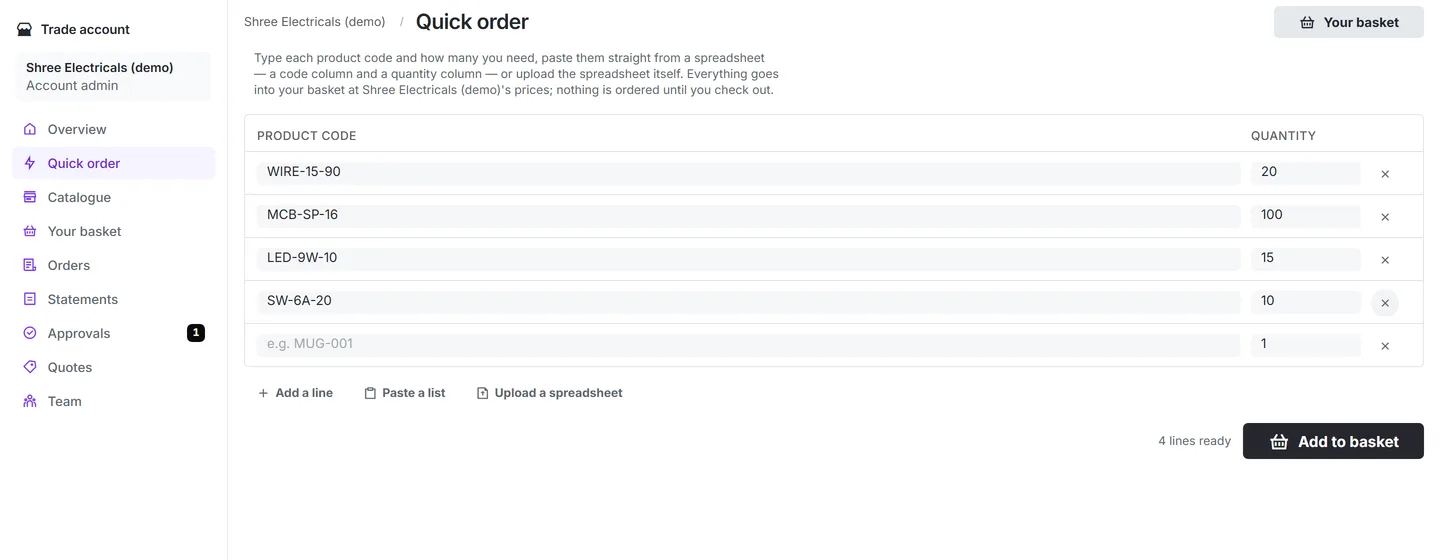
| Orders by part number | Order by product code or spreadsheet. Dealers type product codes and quantities, paste them from a spreadsheet, or upload the spreadsheet itself, up to 500 lines at a time. Lines that cannot be added come back with their row number and the reason, such as too little stock. |
| The same fast movers every week | Repeat an order. Put a past order back in the basket at today’s prices, and order only the lines you tick while the rest wait in the basket. |
| Finding a part by number | Sizes, colours and product codes. Products have options and variants, such as size, colour or wattage, each with its own product code, price and stock. Dealers can search the portal’s catalogue by name or product code. |
| Different prices for distributors, retailers and workshops | A price list per dealer category. Put dealers in groups, such as distributors, A-category and B-category dealers, and give each group its own price list. Prices can drop at quantities you set, and a list can run between two dates, for a scheme. |
| No order past a buyer’s credit | Credit limits that stop an order. Each dealer has a credit limit. At checkout, what they already owe plus the new order’s final total is checked against it, and an order over the limit is refused before it exists, with the amount still available shown. Two orders placed at the same moment cannot both slip under one limit. |
| Pay in 30 days | Orders on account. A dealer with an account orders now and pays later. The order is confirmed straight away with a due date, say 30 days out, and the amount counts against their limit until you mark the order paid. |
| Fewer calls about outstanding amounts | Statements and overdue amounts. A statement for any period: what was owed at the start, every order and payment, and what is owed at the end, with unpaid money split into not yet due, 1–30, 31–60, 61–90 and over 90 days late. You see every dealer’s; a dealer’s owner sees their own, and either can download it as a spreadsheet. |
| Each buyer sees only the ranges they deal in | What each dealer may buy. Limit a dealer to some categories and products. Their checkout, quick orders and quotes keep to it. |
| Stock in several warehouses | Stock in several warehouses. Hold stock in more than one warehouse or godown. Each order line records which one it was taken from. |
| A fleet operator’s large order | Quotes. A dealer asks for a price on a quantity. Your team prices each line, adds a note and an expiry date, and sends it. When the dealer accepts, the order is placed at exactly those prices. |
| GST tax invoices with HSN codes | GST tax invoices. A store in India with a valid GSTIN that sells in rupees issues a GST tax invoice for every paid order, numbered by financial year. It carries your GSTIN and the dealer’s, HSN codes and the place of supply, with CGST and SGST within a state and IGST between states, all from what checkout charged. A product can have its own tax rate, so mixed rates come out right. Delivery is printed without GST, because checkout does not charge GST on it. Your team opens and prints invoices in the admin; dealers do not see them in the portal. |
Screens from the portal itself, with a made-up demo dealer and sample products.
What a parts business will ask about that is not there yet.
Parts are found by name or part number. There is no search by vehicle make, model and year.
You cannot yet require a minimum quantity, or sell only in boxes or cases of a fixed size. Price breaks at a quantity do work.
Your team can take an order over the phone at the dealer’s prices, but it cannot be placed on the dealer’s credit account. There is no salesperson role or beat plan.
The GST tax invoice has no IRN or signed QR code, and no e-way bill is made: both need an account with a GST Suvidha Provider or the Invoice Registration Portal. A supplier whose turnover has passed ₹5 crore in any year since 2017-18 must e-invoice its sales to registered businesses, and still needs its billing software for that. A return or refund issues no GST credit note, and an order on account gets its tax invoice only when you mark it paid, not when it ships.
Tax invoices download as TallyPrime import files that follow Tally’s published format, but they have not yet been test-imported into TallyPrime itself. Someone downloads the files and imports them: nothing flows into Tally by itself. Other accounting systems get spreadsheets of orders, customers and statements, or the webhooks and API.
GoCommerce has over 2,000 tests, but no store we know of runs it in production yet. You would be among the first, and the team behind it can set it up with you.
FAQ
Yes. Paste part numbers and quantities, or upload a spreadsheet of up to 500 lines. Numbers that cannot be ordered come back with the row number and the reason, such as too little stock.
No. The catalogue is searched by product name or part number. A vehicle make, model and year search is not built.
Yes. Put each kind of buyer in a group with its own price list, with lower prices at quantities you choose.
Not yet. Your team can enter a phone order at the retailer’s prices, but it cannot go on the retailer’s credit account. Retailers place credit orders themselves in the portal.
Yes, for a store in India with a valid GSTIN that sells in rupees: every paid order gets a tax invoice with HSN codes and the CGST, SGST or IGST split, and the invoices export to TallyPrime. There is no e-invoice, e-way bill or GST credit note, and delivery is printed without GST.
Facts about the trade on this page come from the pages below, read on 26 October 2026. What GoCommerce does was checked against its code on the same day.
Start a store hosted on kitcommerce.store for 1% of every successful order, plus 18% GST on the fee, or run the open-source code on your own server for free. Either way the admin and the trade portal are on the store’s own web address.