Dealer portal
A dealer and distributor ordering portal on your own web address: orders, credit, statements, approvals and quotes.
B2B ecommerce in India
GoCommerce lets a manufacturer or distributor take its dealers’ orders online. Each dealer signs in on your own web address, orders by product code at their own prices, buys on credit up to the limit you set, and downloads a statement of what they owe. It is open source. A store with a GSTIN issues GST tax invoices and exports them for TallyPrime, though not e-invoices, and this page lists what else is missing.
The questions owners and sales heads ask first. Each answer is something the software does now.
| You need | What it does today |
|---|---|
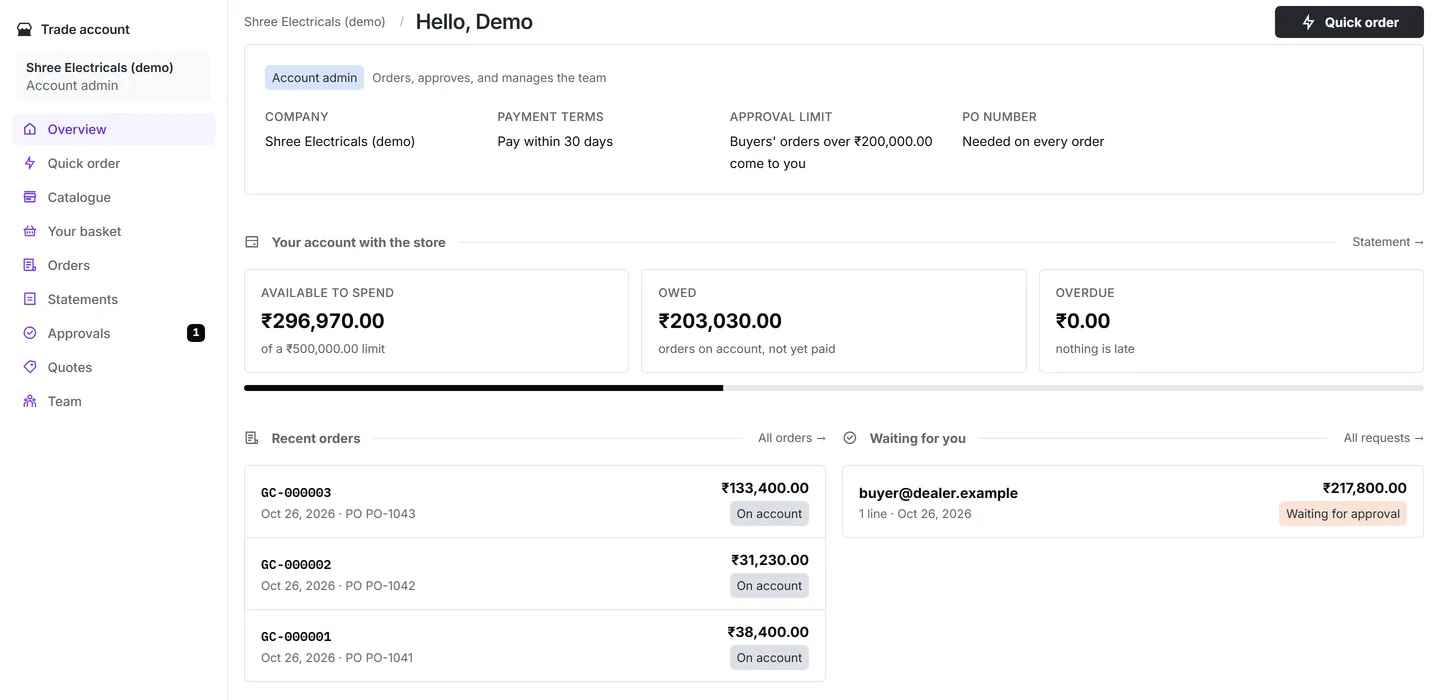
| Dealers ordering without phoning us | A dealer portal on your own web address. Dealers sign in at /portal on your store’s own address. They see their payment terms and what they owe, order, approve their staff’s orders, accept quotes and download statements. There is no separate website to build first, and it works in a phone’s browser. |
| Each dealer at their own price | A price list per dealer category. Put dealers in groups, such as distributors, A-category and B-category dealers, and give each group its own price list. Prices can drop at quantities you set, and a list can run between two dates, for a scheme. |
| No dealer ordering past their credit | Credit limits that stop an order. Each dealer has a credit limit. At checkout, what they already owe plus the new order’s final total is checked against it, and an order over the limit is refused before it exists, with the amount still available shown. Two orders placed at the same moment cannot both slip under one limit. |
| Credit on 30, 45 or 60 days | Orders on account. A dealer with an account orders now and pays later. The order is confirmed straight away with a due date, say 30 days out, and the amount counts against their limit until you mark the order paid. |
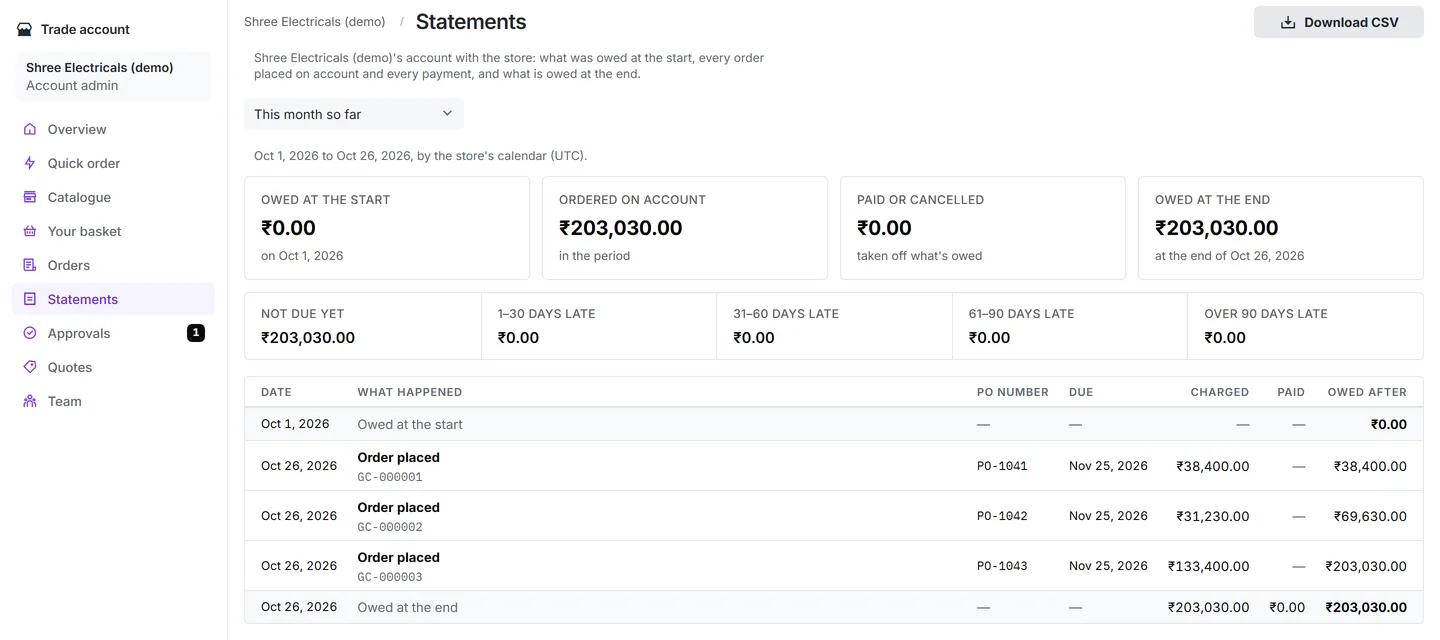
| Dealers asking what they owe | Statements and overdue amounts. A statement for any period: what was owed at the start, every order and payment, and what is owed at the end, with unpaid money split into not yet due, 1–30, 31–60, 61–90 and over 90 days late. You see every dealer’s; a dealer’s owner sees their own, and either can download it as a spreadsheet. |
| GST tax invoices with HSN codes | GST tax invoices. A store in India with a valid GSTIN that sells in rupees issues a GST tax invoice for every paid order, numbered by financial year. It carries your GSTIN and the dealer’s, HSN codes and the place of supply, with CGST and SGST within a state and IGST between states, all from what checkout charged. A product can have its own tax rate, so mixed rates come out right. Delivery is printed without GST, because checkout does not charge GST on it. Your team opens and prints invoices in the admin; dealers do not see them in the portal. |
| Invoices into our accountant’s Tally | Invoices ready for TallyPrime. Download a period’s GST tax invoices as two TallyPrime import files, ledgers first and then vouchers, so nobody types them in again. Each invoice becomes one sales voucher that matches it to the paisa, each dealer with a GSTIN gets a ledger of its own, and you set the ledger names once to match your accountant’s company. |
| Big orders from a dealer’s staff | The owner approves big orders. Set an amount per dealer. When a dealer’s staff member orders above it, the order waits, and the dealer’s owner or approver is emailed to approve or reject it. Approved orders go through at the prices the approver saw. |
| Special prices for a large order | Quotes. A dealer asks for a price on a quantity. Your team prices each line, adds a note and an expiry date, and sends it. When the dealer accepts, the order is placed at exactly those prices. |
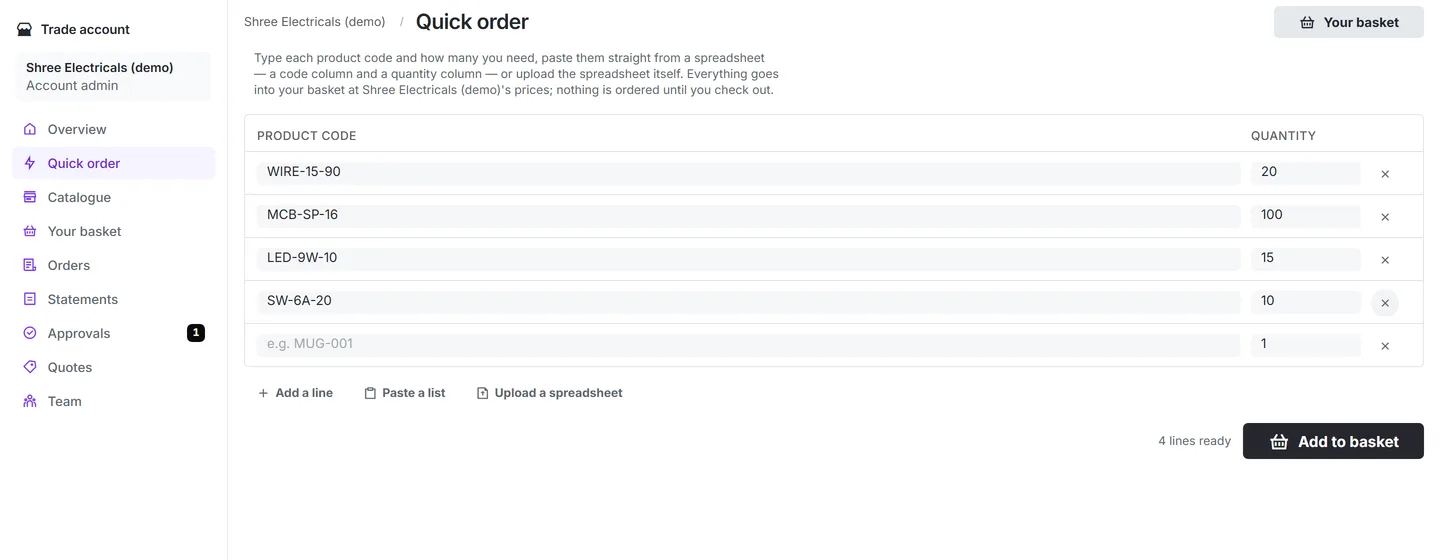
| Orders sent as a spreadsheet | Order by product code or spreadsheet. Dealers type product codes and quantities, paste them from a spreadsheet, or upload the spreadsheet itself, up to 500 lines at a time. Lines that cannot be added come back with their row number and the reason, such as too little stock. |
| Customer enquiries sent to the right dealer | Dealer territories. Give each dealer a territory: a country, a state or a PIN code prefix. An enquiry from a customer on your website goes to the dealer whose territory fits best, and that dealer is emailed and follows it up in the portal. You see every enquiry and can reassign it. |
| Shipping with Indian couriers | Indian couriers. Book shipments with Shiprocket, Delhivery or NimbusPost from the admin. The India Post module records the consignment number from the counter receipt. |
| Getting orders into our other systems | Connect your other systems. Export orders, products, customers and stock as spreadsheets. Webhooks send each new and changed order to another system, and API keys let a system you trust read or place orders without a person signing in. |
| Not being locked in | Open source, so it stays yours. GoCommerce is MIT licensed. Run it on your own server for free, or have it hosted on kitcommerce.store for 1% of every successful order, plus 18% GST on the fee, and take the code with you if you leave. |
Screens from the portal itself, with a made-up demo dealer and sample products.
It fits best where dealers reorder known products by code and buy on credit: electricals and fans, tiles, sanitaryware, plywood and pipes, and auto parts sold by part number. Each has its own page below, with what that trade asks for.
It does not fit yet where the law or the trade needs more than the software has. Medicines and crop protection need batch and expiry records and a licence check on every buyer. Jewellery is priced by weight at the day’s gold rate. FMCG distribution runs on salespeople taking orders shop by shop. None of these is built yet.
What an Indian supplier will ask about that is not there yet. Read these before you plan a launch.
The GST tax invoice has no IRN or signed QR code, and no e-way bill is made: both need an account with a GST Suvidha Provider or the Invoice Registration Portal. A supplier whose turnover has passed ₹5 crore in any year since 2017-18 must e-invoice its sales to registered businesses, and still needs its billing software for that. A return or refund issues no GST credit note, and an order on account gets its tax invoice only when you mark it paid, not when it ships.
Tax invoices download as TallyPrime import files that follow Tally’s published format, but they have not yet been test-imported into TallyPrime itself. Someone downloads the files and imports them: nothing flows into Tally by itself. Other accounting systems get spreadsheets of orders, customers and statements, or the webhooks and API.
Dealers cannot order over WhatsApp, and approvals, quotes and statements are sent by email. Order status texts to customers go by SMS through the MSG91 module.
Product names can be in Hindi or another Indian language, but the portal’s own buttons and screens are English only.
In the portal, dealers order on account. Paying by UPI or card through Razorpay or Cashfree works on your store’s checkout, but not yet from the portal’s basket. Payments are recorded against whole orders, not part payments.
GoCommerce has over 2,000 tests, but no store we know of runs it in production yet. You would be among the first, and the team behind it can set it up with you.
FAQ
Software that lets businesses order from you online instead of by phone, email or a salesperson. Here that means your dealers and distributors sign in, see their own prices and credit, place orders and download statements, while you set the terms in an admin.
Yes. Give each dealer a credit limit and payment days. An order on account is confirmed straight away with a due date, and an order that would take the dealer past their limit is refused at checkout, before it exists.
Yes, when your store’s profile is in India with a valid GSTIN and it sells in rupees. Every paid order gets a tax invoice with both GSTINs, HSN codes, the place of supply and the CGST, SGST or IGST split. It does not make e-invoices, e-way bills or credit notes, and delivery is printed without GST. An order on account gets its invoice when you mark it paid.
It exports to TallyPrime. A store that issues GST tax invoices downloads a period’s invoices as two import files, ledgers then vouchers, for your accountant to import. The files follow Tally’s published format but have not yet been test-imported into TallyPrime itself. Orders, customers and statements also export as spreadsheets, and a developer can connect another system through webhooks and the API.
No. Dealers sign in at /portal on your store’s own web address. A public website for customers can come later, or never.
Running the open-source code on your own server is free. A store hosted on kitcommerce.store pays 1% of every successful order, plus 18% GST on the fee, cash-on-delivery and on-account orders included. If you would rather someone set it up, the team behind GoCommerce builds stores to order.
Facts about the trade on this page come from the pages below, read on 26 October 2026. What GoCommerce does was checked against its code on the same day.
Start a store hosted on kitcommerce.store for 1% of every successful order, plus 18% GST on the fee, or run the open-source code on your own server for free. Either way the admin and the trade portal are on the store’s own web address.