Open-source ecommerce storefront built with Svelte
Svelte Commerce provides a fast, customizable storefront for headless ecommerce, built around the Svelte ecosystem. It is a standalone project that connects to GoCommerce or another compatible commerce backend.
- MIT licensed
- SvelteKit
- 26 backend connectors
- Public for years
Built with Svelte Commerce
Open source, in the open
1,813
Stars on GitHub, read live from the API.
335
Forks — the project has been public for years.
26
Backend connectors, from Litekart to OpenCart.
43
Services in the shared connector surface.
Star and fork counts are read from the GitHub API on load, falling back to the values measured on when the unauthenticated call is rate limited.
Storefront screens
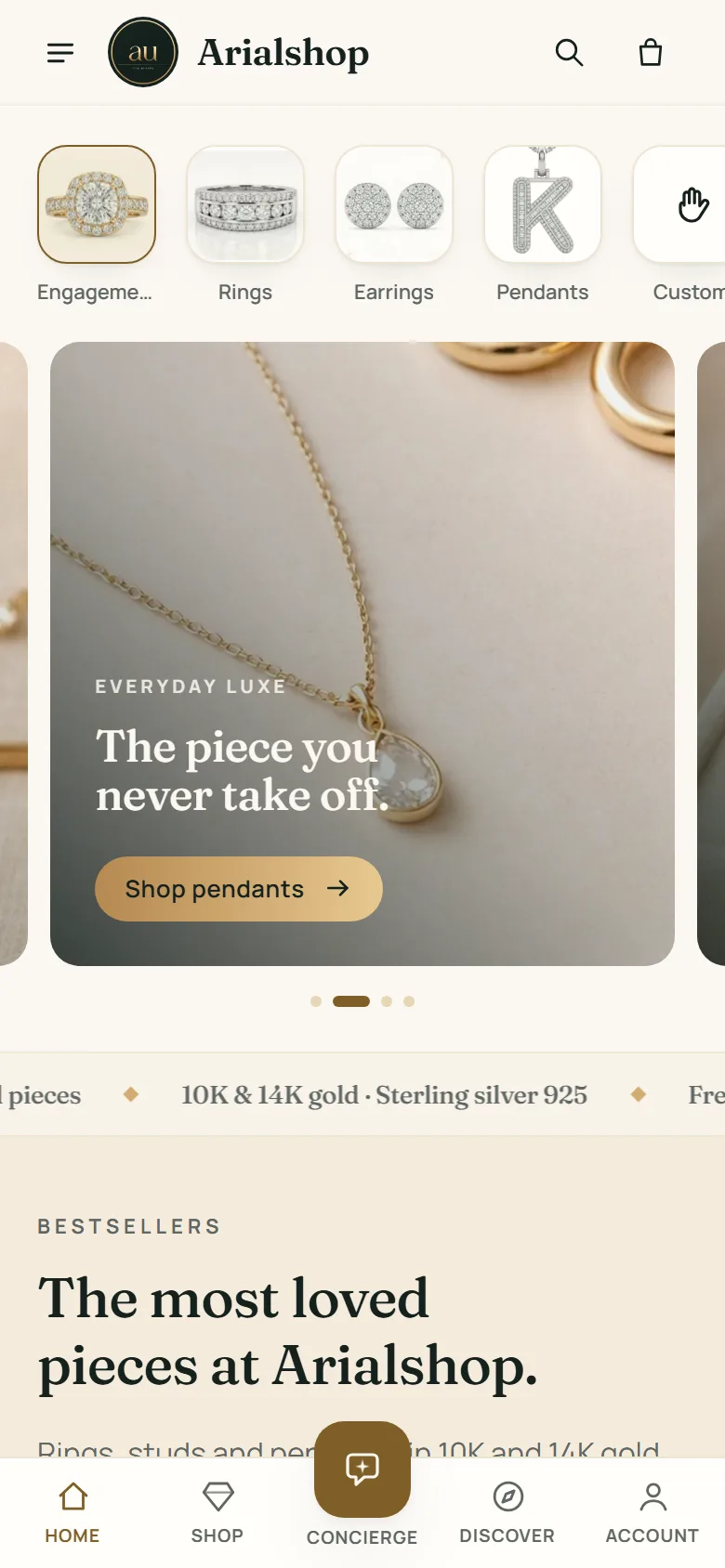
Real captures from arialshop.com, a production store running Svelte Commerce, taken on .


What the storefront does
- Product discoveryCategories, collections, listing pages.
- SearchOver the backend’s own search service.
- CartWired on 23 of the 26 connectors.
- CheckoutWired on 25 of the 26 connectors.
- Responsive UIOrdinary Svelte components, not a theme DSL. See 79 live themes.
- Backend adaptersOne shared 43-service surface, 26 implementations.
Those cart and checkout counts are per-connector rather than universal, because what a storefront can do depends on what its backend exposes. The matrix says which is which.
Backend compatibility
26 connectors exist. These are the six most complete, by measured coverage of the 43-service surface.
- Litekart39/43
- Vendure39/43
- Medusa31/43
- Broadleaf28/43
- Saleor28/43
- Shopware28/43
Shopify, WooCommerce, Magento, PrestaShop, commercetools, Spree, Sylius and eighteen others are also wired, at varying completeness. Coverage is traced by a script rather than asserted, and no connector has yet been exercised against a live production instance of its platform.
View all 26 backend integrationsUsing it with GoCommerce
GoCommerce ↔ Svelte Commerce
Connector: early (0.1.0)
GoCommerce is not one of the 26 measured backends. Its connector, @misiki/gocommerce-connector, lives in the GoCommerce repository and has been on npm at 0.1.0 since 2 September 2026.
It covers the path from a shelf to a placed order: catalogue, cart, checkout and order lookup. Customer accounts and a search index are not covered, a service it does not map throws an error naming that service rather than rendering empty, and no store is known to run the pair in production.
Run the storefront locally
You need Node.js and a commerce backend to point it at. The storefront holds no data of its own, so it needs something to read from before it shows a catalogue.
Clone it, install, choose a connector
# 1 — get the source
git clone https://github.com/itswadesh/svelte-commerce
cd svelte-commerce

# 2 — install dependencies
bun install

# 3 — the backend IS the connector package. Swapping it is the switch.
bun remove @misiki/litekart-connector
bun add    @misiki/vendure-connector

# 4 — every backend but Litekart needs its own PUBLIC_<NAME>_* env
cp .env.example .env

# 5 — run it
bun dev
There is no per-backend module to uncomment: $connector resolves from package.json, and PUBLIC_CONNECTOR overrides it when more than one is installed. The repository’s CONNECTORS.md is the authority on each one’s environment variables.
FAQ
Questions people actually ask
Direct answers, including the unflattering ones. If a question here has a bad answer, that is the answer.
Which commerce backends does Svelte Commerce support?
26 connectors exist today. Litekart and Vendure are the most complete at 39 of 43 services; Medusa is at 31, Broadleaf, Saleor, Shopware and Virto Commerce at 28, WooCommerce at 27, and the rest range down to OpenCart at 9. Coverage is measured by a script rather than asserted.
Can I use Svelte Commerce with GoCommerce today?
Yes, through an early connector. @misiki/gocommerce-connector 0.1.0, on npm, lets Svelte Commerce browse a GoCommerce catalogue, fill a cart, check out and look up an order. Customer accounts and a search index are not covered, and no store is known to run the pair in production. Install it in place of the connectors Svelte Commerce ships with and set PUBLIC_GOCOMMERCE_API_URL.
Does Svelte Commerce need GoCommerce?
No. Svelte Commerce is a standalone storefront and predates GoCommerce by years. It runs against any of the 26 backends it supports today; GoCommerce is not one of those, and is reached through a separate, early connector.
Is it production-ready?
It has been public for years and runs production stores — arialshop.com is one of them, and it is linked on this page so you can judge it yourself rather than take our word for it. The connectors are a separate question: none of the 26 has been exercised against a live production instance of its platform.
How do I switch backends?
Remove one connector package and add another. Nothing in the storefront imports a connector by name — the active one resolves from package.json, with PUBLIC_CONNECTOR to override — so switching is a dependency change rather than a rewrite.
Can I change the design?
Yes. The storefront is ordinary Svelte components rather than a theme DSL, so changing a template means editing that template. It is MIT licensed, so you can rebrand it and ship it for a client.
Is it good for SEO?
Product and category pages are server-rendered by SvelteKit, so a crawler receives HTML with the catalogue in it rather than an empty shell. The rest of a store’s SEO — titles, structured data, canonical URLs — is yours to write, as it is in any storefront.
Is there a paid tier?
No. It is MIT source you run yourself. There is no hosted offering, no paid tier and nothing to buy.
Build the storefront, keep the backend you have
SvelteKit in front of any of 26 commerce backends. Yours under MIT.